The
Fingerprint
Motif

A permanent signature. Not a logo.
Executed through tension, thread, and cut.

Video — Macro / Top Shot · 60–90 s

The Fingerprint motif in process

Real hands, top-down/macro shot of the motif being embroidered — no face. Textile sound only or silence, no music. Optional overlay (max 6 words): "No two are identical." or "Cut to the thread." Desktop: 1920×1080 (16:9). Poster frame: first frame of clip, /images/fingerprint-video-poster.jpg.

+ Mobile cut: vertical 1080×1920 (9:16), same footage reframed closer to hands.

Image — Macro · White / Blue

Fingerprint Motif — White / Blue (47.jpg)

Frontal macro of the finished motif on white fabric, blue background visible through the relief. Soft, even light — no hard shadows on the ridges. Horizontal 1200×800.

+ Mobile: same framing, tighter crop, square 1:1 or 4:5 — ridges fill the frame.

The Fingerprint motif at Migula Studio is not a graphic. It is not printed. It is not embroidered onto a base. It is a pure flat-relief structure — a signature built into the fabric through tension, direction, and a surgical cut.

How the motif is built

The Fingerprint is executed with thread tension alone. No synthetic skin. No elevated base structure. It is flat-embossed embroidery — the shape remains within the fabric surface rather than emerging from it. Depth is built by varying the density and direction of thread passes within a strictly defined field.

The ridges are not traced from a template. They are placed by reading the fabric beneath — following thread direction, responding to the tension already present in the surrounding embroidery. Each Fingerprint motif is shaped in part by the piece it appears on. The fabric determines the final line.

Every piece carries the same motif. No two executions are identical. That is not a contradiction — it is the definition of a signature.
— Darius Migula

Surgical curve engineering

From a technical standpoint — my Codex, my Level 3 — this motif is a complete test of patience. The fingerprint is hundreds of concentric arcs, perfectly aligned. Organic but designed. The slightest shift of the fabric in the frame would destroy the hypnotic, rhythmic pattern.

Tension must be absolute. The spacing between stitches must be exact to the millimetre. And then comes the cut.

As with every piece that leaves my atelier, the cut is made from the back — never from the front, never visible until the structure is turned. Working by touch alone, I follow the line of the stitches themselves, releasing the relief from below. No cut around the outer edge of the motif — no edge, no appliqué seam. Only the structure itself rises forward. One careless move from the back and I would cut through the embroidery, breaking the relief before it emerges. The final result is a pure three-dimensional surface. The pattern literally lifts off the shirt. It is a texture felt before it is seen. A topography of the hand.
Fingerprint Motif by Migula Studio, reverse view — hand-cut release, raw thread and synthetic skin inner layer, Monolit Method

White/Blue · Black/Red

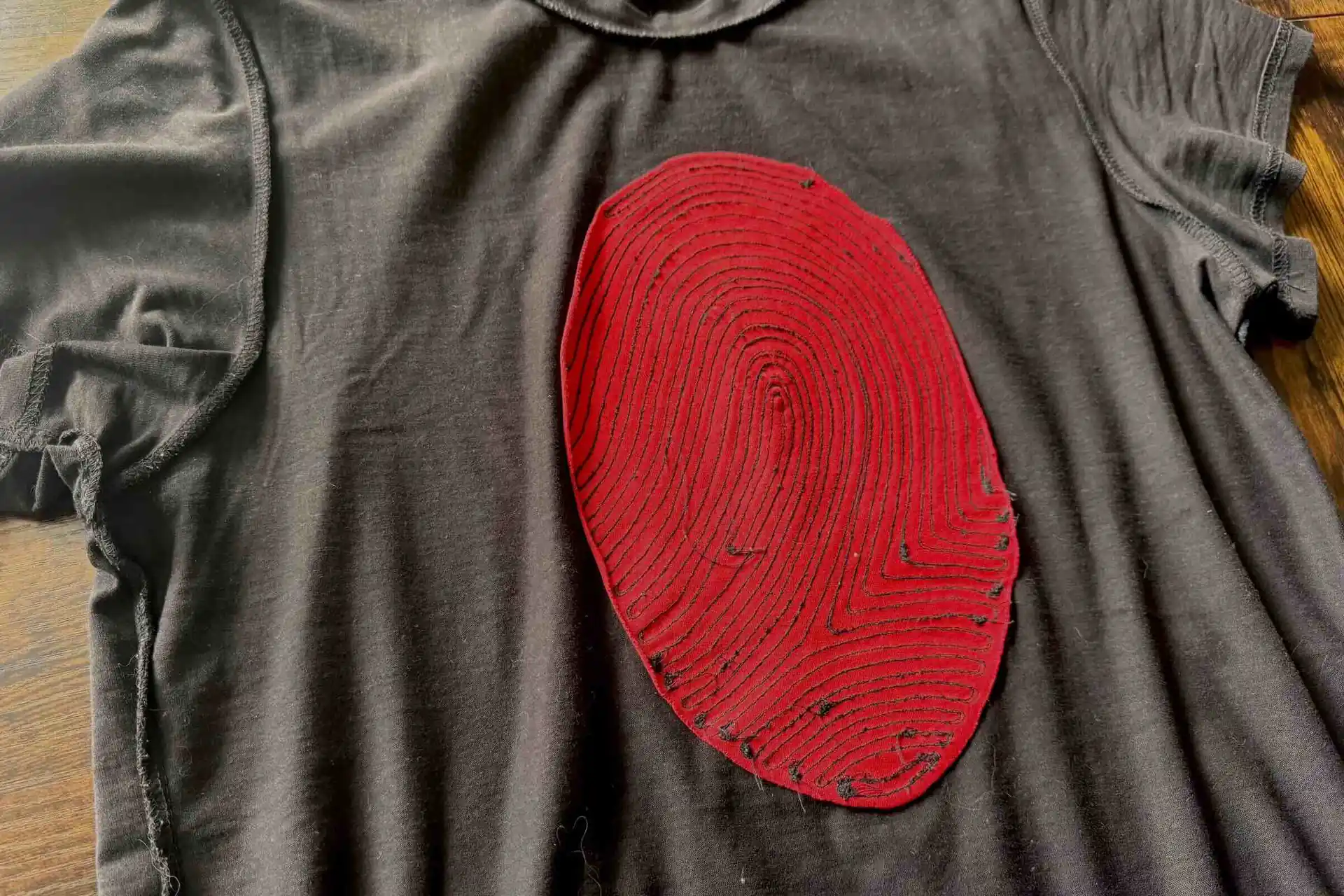
The same motif, the same method, the same hand. But the identity changes completely depending on how I direct the colour. In the white piece, a deep electric blue lies beneath the white ridges — the cut reveals an oceanic coolness. In the black piece, a volcanic red pulses in the darkness — the cut reads like a fissure in armour. The technique is identical. The result is dual. That is the point.

A motif that looked identical regardless of the piece it was on would be a logo. The Fingerprint is not a logo. It is evidence.

Technical specifications

MethodFlat embossing — no inner layer, no interfacing
TensionHand-tensioned in frame — zero shift tolerance
SpacingExact to the millimetre — concentric arcs
CutFrom the back, by touch — surgical scissors following stitch lines
DepthThread density and direction — pure 3D relief
Colour applicationHand-painted beneath the embroidery layer
Base100% heavy-weight cotton, pre-washed
EditionNo two motifs are identical — each shaped by the fabric it is cut into

The Process

1

Fabric Calibration

The cotton panel is inspected under raking light. Any surface irregularity at this stage becomes a structural defect in the final relief. The grain must be perfectly aligned before the first stitch.

2

Tension Lock

The panel is stretched on the hoop with zero shift tolerance. The tension is set at the exact point where the fabric's natural memory begins to resist — this is the equilibrium the embroidery will lock into.

3

Arc Embroidery

Hundreds of concentric arcs are embroidered by hand, following the fabric's thread direction. Each pass is tensioned individually — the spacing must be exact to the millimetre, or the hypnotic pattern collapses.

4

Colour Application

The background colour is hand-painted beneath the embroidery layer. The pigment is applied to the substrate before the cut — what shows through the relief is determined now, not later.

5

Underside Release

Removed from the hoop, the piece is turned over. Working by touch with surgical scissors, the embroidery lines are cut from beneath — never the outer edge. One wrong cut and the relief breaks before it emerges. The structure rises forward. The signature is complete.

The fingerprint is not a stamp. It is a record. A record of the hand, the tension, the cut. Every piece is a separate event.
— Darius Migula

Why it works

The industry conversation in 2026 is dominated by questions of authenticity — how a brand proves that its identity is real and not constructed. The answer most brands give is narrative: the founder's story, sourced materials, supply chain documentation. These are all descriptions of authenticity. None of them is the thing itself.

The Fingerprint motif is a different answer. It is not a description. It is the mark the hand leaves on every piece the hand makes. The variation between executions is the proof — a stamp produces identical results. A hand does not. The variation is the authentication.

A collector looking at two pieces carrying the Fingerprint motif is looking at two separate events. Two separate applications of the same method by the same person. The motif does not retire because the person does not retire. It evolves as the hand evolves. That is the only way a signature should work.

Image — Macro · Black / Red

Fingerprint Motif — Black / Red (25.jpg)

Frontal macro of the finished motif on black fabric, red background visible through the relief. Soft, even light — no hard shadows on the ridges. Horizontal 1200×800.

+ Mobile: same framing, tighter crop, square 1:1 or 4:5 — ridges fill the frame.

Image — Detail · Texture

Fingerprint Motif — Thread Detail (NEW)

Extreme macro of individual thread passes showing concentric arc alignment and tension distribution. Raking light from 45 degrees. Horizontal 1200×800.

+ Mobile: vertical crop focusing on arc intersection, 1080×1350.

Direct Correspondence

By appointment · Łódź / Berlin

The Ladder

Five levels. One method. One signature.

The Fingerprint motif appears on every level of the ladder. Explore the system — and where each piece sits within it.